Game Types: Cash vs GPP
The highest-projected lineup is the correct play in a cash game and a losing one in a big GPP. Same slate, same player pool, opposite math. If you build one lineup and enter it in both, you're wrong somewhere.
The reason is the payout structure, not the players. Cash games (double-ups, 50/50s, head-to-heads) pay everyone above roughly the median the same. GPPs pay the top sliver almost everything and pay most of the field nothing. Those two shapes reward completely different lineups, and playing one style in the other contest is one of the most common ways people lose money that looks like bad luck.
Cash: just beat half the field, and chalk does that
In a cash game your only job is to finish above the line. You don't get extra for finishing first. So you want the most expected points you can roster, full stop. That means the chalk, and the data is blunt about why.
Here's mean actual points grouped by how heavily projected each player was owned, across our Showdown slate history:
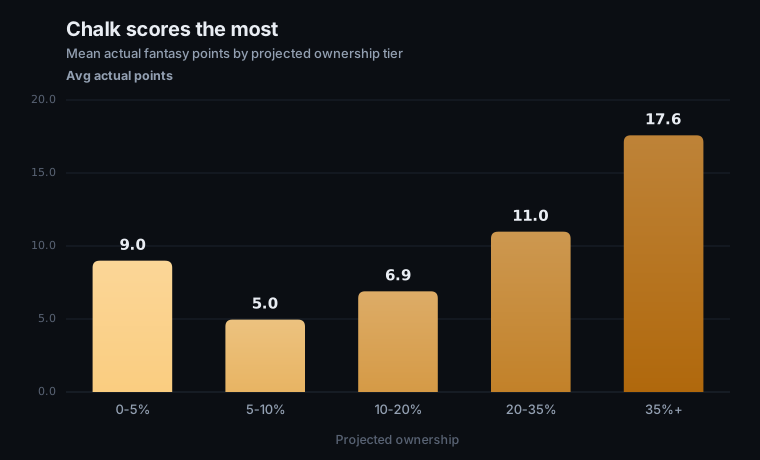
The heaviest-owned tier, players the field projected at 35% and up, averaged 17.6 actual points. Every other bucket sat below 11, and the lowest-owned players averaged 9.0. The crowd piles onto those players because they're the best plays, and on average they are the best plays. In cash, that's the whole story. Rostering a low-owned punt to be different just hands away expected points for a prize structure that doesn't reward being different. Fading chalk in cash is lighting money on fire.
The GPP trap: the ceiling belongs to the chalk too
The instinct is to carry that logic into tournaments. If chalk scores most, load up on chalk everywhere. It gets worse when you look at ceilings, because chalk wins those too.
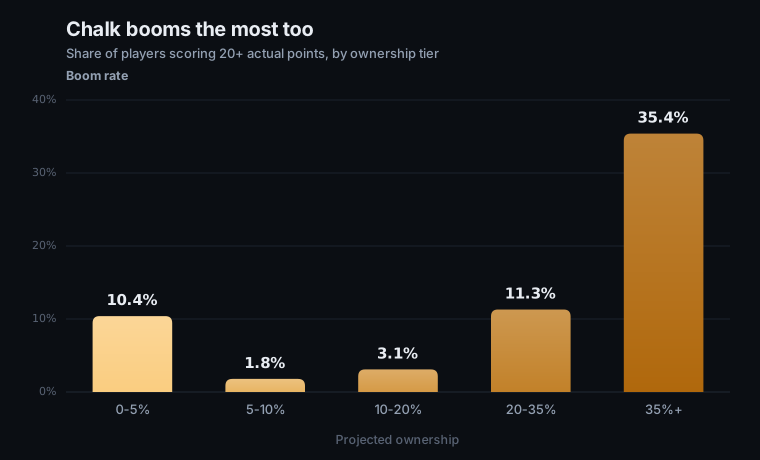
Players owned 35% and up hit 20-plus points 35% of the time. The lowest-owned tier got there only 10% of the time. So the popular plays aren't just safe, they have the best odds of a monster game. If GPPs were about who scores the most points, you'd play chalk there too and be done.
They aren't. And here's why the highest-projected lineup quietly loses tournaments.
Your rank is set by the players you have that nobody else does
In a big GPP you're not being measured against a scoring line. You're being measured against thousands of other lineups. Your finish is decided entirely by the players you rostered that most of the field didn't.
Run the chalk boom through that lens. A 35%-owned player goes for 30. Great night for him, and a third of the field had him. You gained nothing on those people. The chalk boom is already priced into everyone's score, so it can't move you up. It only keeps you from falling behind.
Now the other one. A sub-5%-owned player booms. It happens about 10% of the time, and when it does the ceiling is real. The top single-game score in that lowest-owned tier was 55 points. When you have that player and 95% of the field skipped him, you don't climb a few spots, you climb past nearly everyone who didn't. That's leverage, and it's the only thing that gets you to the part of a GPP that pays.
So the tournament trade is deliberate. You give up some expected points, the sub-5% tier averages half what the chalk averages, in exchange for lineups the field can't match. Correlation is how you make that trade pay off instead of just praying: stack players whose big games happen together, the quarterback with his receiver, the receiver with the game going shootout, so when your low-owned piece pops, the rest of your lineup pops with it. One correlated ceiling that lands beats six random longshots that don't.
Boom or bust, on purpose
GPP lineups are supposed to be fragile. You are trying to build the top 0.1% or nothing, because that's where the money is. Most weeks a good tournament lineup finishes out of the money and that's fine. It's not a failed cash lineup, it's a lottery ticket that didn't hit. Long term you come out ahead only by landing some of those top finishes, and the payouts up there are big enough to carry a lot of misses.
No projection saves you from that variance, either. Across the same data our projections missed a player's actual score by 4.6 points on average, and that's the good case. Nobody can reliably pick which longshot pops this week. What you can do is build a range of correlated, lower-owned lineups so you have exposure to several of the outcomes that would win, and accept that most of them won't.
That's the split. Cash rewards being right about who scores. GPPs reward being right about who scores and being alone in it. The best cash lineup maximizes the first. The best GPP lineup sacrifices some of the first to buy the second.
How Pylon builds each one
It's the same engine with the levers set differently. For cash, crank projection weight, ignore ownership, and take the optimizer's top build. For GPPs, turn on ownership caps and leverage, add your stacking rules so your ceiling is correlated, and use the variance dial so you don't end up with 20 near-copies of one lineup. The tool doesn't force one philosophy on you. It lets you build for the contest you actually entered.
Which raises the next question, and it's the one that moves ROI more than most lineup tweaks: which contests should you enter in the first place? Small-field versus massive-field, flat payouts versus top-heavy, how many entries. That's the next post.
To be clear, this is strategy, not a promise. DFS is hard, variance is real, and none of this guarantees a profit. Pylon is an independent tool and isn't affiliated with or endorsed by DraftKings.